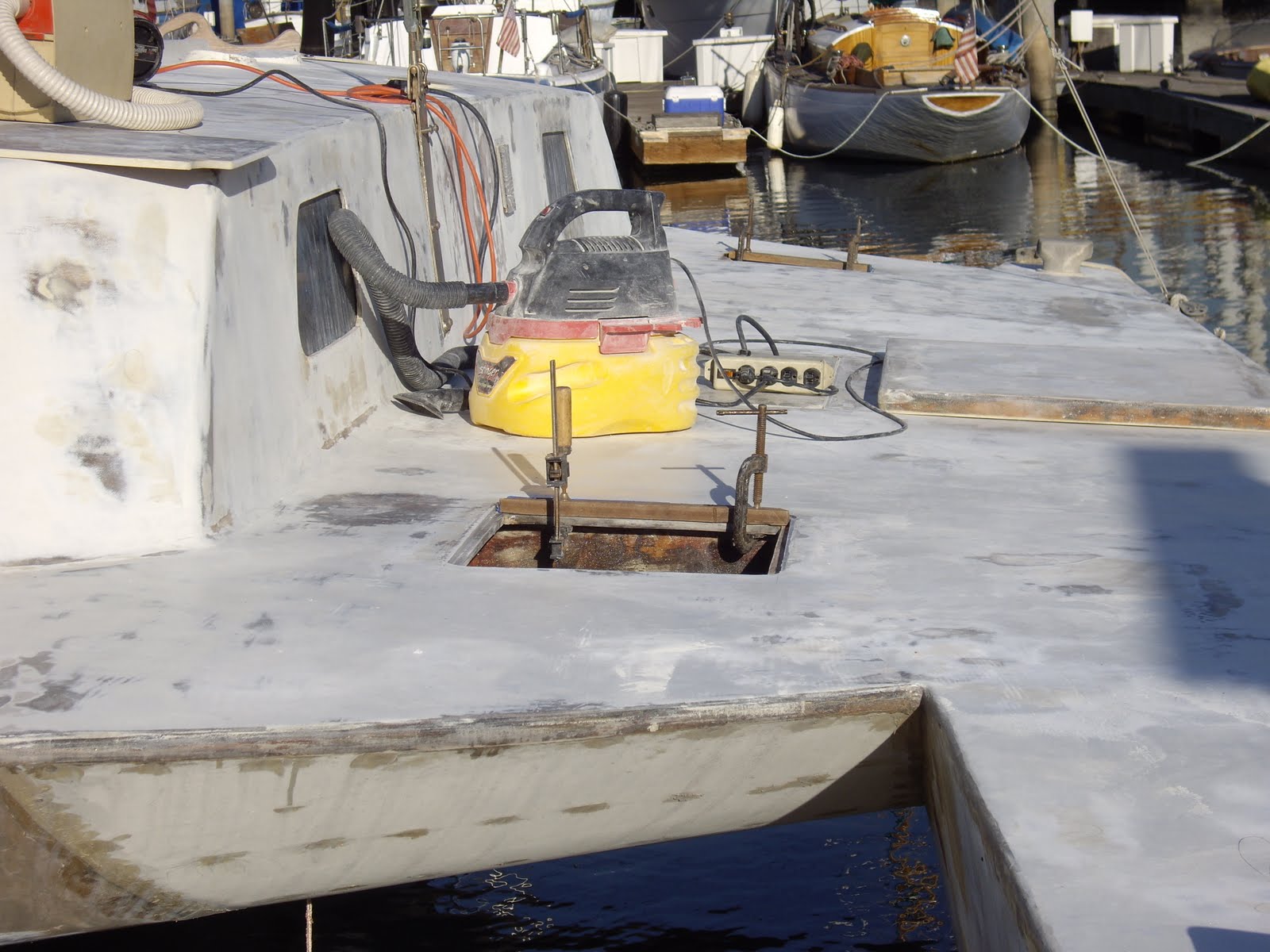
After getting all the teak runners off the cockpit sole, epoxy coating the old plywood, and meticulously sealing all the staple holes, I found the sole halves on both sides of the now-open centerboard trunk top were not epoxied down to the frames they rested on! They were merely put down with a caulking compound that still held them, but with just a little lifting, I took them both off by hand. No wonder water could migrate into areas it should not have. The port side of the trunk had the sole screwed along the trunk edge, but the starboard side just lifted right off. So, the new plan is to replace these pieces of old ply with new. Here is how the area looks without the soles:
Doreen is scraping the debris off the support stringers. Her left hand is on the starboard side of the open trunk top. This picture shows just how deep the stowage area is on the starboard side with the sole of the cockpit removed. The port side houses the Farymann diesel engine covered in black plastic and not visible.
Seen from a different angle, here is that same compartment now partially sanded preparatory for new primer and paint before putting the lid on it (the new cockpit sole):
The three 3/4" inch holes at the bulkhead are to be filled with epoxy mix and re-drilled for adding a plate to cover the front of the trunk from the sole level down about 14" to the sub-sole area where the mast base is located.
Above is another view of the trunk from forward of the bulkhead seen in the preceding photo. You are looking aft at both compartments on both sides of the trunk. The white tube on the port side is a support piece with a track bolted to it with a traveler car on it. Hanging from the car there is a turnbuckle which attaches to a lift point on the engine for sliding it fore and aft in the compartment along its bed. By lifting it with the turnbuckle from the bed, it can be pulled aft to the opening at the galley. From there with a halyard from the mast top it is lifted up and into the cockpit for removal and replacement. I have down it a couple of times now with one other person and it works well despite its weight.
Very visible in this photo are the six holes in the upper part of the cross beam. Below are four more holes that do not penetrate completely. Nuts for the cover plate will be bedded in these partial holes for removal of the vertical cover plate for removal of the centerboard. It too can be hoisted out of the trunk with the main halyard once this opening and the steering mechanism is removed. Therefore, all the steering items attached here must be removable but securely attached to the front of the centerboard trunk. That is the engineering project I am immersed in right now.
Here is the front plate that covers the vertical part of the trunk and will mate with the holes shown on the bulkhead that supports the steering mechanism. I call this piece of 3/4" ply "Mr. Tee" for obvious reasons. Note the edges all have been coated with epoxy and filler to seal the plywood end-grain. The over-sized holes will get epoxy bog and be re-drilled for the bolts that will secure it to the bulkhead. This panel will be removable and serve as the main attachment of the steerer.
As can be seen in the picture below, the blocks that control the up and down of the centerboard need access and inspection for appropriate replacement. This old Schaefer cheek block was removed from the aft end of the trunk. The sheave still turned, but most of the aluminum plate on the top side of the unit has corroded away. Three of the four attachment bolts held, but one fell off in my hands when I removed it. To get to the unit, there is a small oval hole just above the block that was covered over with a large piece of 3/8" plywood secured with some of the same white mastic that held down the soles. Chisel and hammer work and I got the plywood off for access to the inspection port. Then a few sharp blows with my hammer and the small hand-size piece of plywood came out. Now I must build a new and better inspection port that will allow easy and frequent access to the new cheek block once it is in place. The plans call for a minimum 3/8" axle for the sheave, and this one is perhaps 1/4" only. The new one will be overkill with no aluminum anywhere! The waterline currently is just below this block but underway there is a lot of water that moves around in the trunk and keeps this metal wet with salt water. Ideally a small zinc anode should be added to the block.
Another view of the corroded old thing: Amazing it still held when i pulled the board down!
So, with about 20 different projects going on at once, the primary focus right now is to get the new sole in place covering the engine and stowage compartments on both sides of the trunk. In order to accomplish this goal, I need to finish sanding and painting in the compartments now that they are more accessible with the sole on both sides of the trunk removed.
Keeping the dream alive and the enthusiasm going is paramount to the success of the overall project. I have leaned heavily on posts from Mark Johnson of the Searunner 34 Delphys. Mark has been exceedingly helpful with ideas, his experience going down this same road. His photos on the Searunner thread of the Cruisers Forum is filled with good advice, excellent photos, and lots of detail. Others have been helpful in keeping me on the right track. John Marples was very quick in sending me several of the pages to the plans i requested. Dave Weber came by for a few days and shared some of his thoughts about the 34's he has seen in his travels. Mike Lenemen is in the wings as soon as I need him for some rigging expertise. Roy Mills helped with some thoughts on bedding compounds when I called him on the phone. It is this large multi-hull community and Searunner sailors specifically that are a viable part of keeping me going. Jack Molan has been a world of help with his information on synthetic standing rigging and all the photos he has of his SR-34 Corazón in Mexico. A number of vendors have been helpful for much of the on-line purchasing I do of epoxy, fiberglass cloth, peel ply, boat hardware, and myriad other items that go into such a major project as refurbishing and re-outfitting an old boat.
Without the continuous positive help of my first mate and wife Doreen, this effort would not reach fruition. We share a common goal of getting Etak cruise-worthy. Her preparation of nutritious food and logistic help is vital to the process. Doing it alone I would find myself hard pressed to work hard, then eat well after all the work.
We are fortunate to have lots of boat stuff stored in a few locations. My nephew and niece, a mere 12 miles away have several crates of boat goodies. Our friend Al and his wife have a storage shed full of cushions, sails, lines, chain and anchors that would be impossible to keep on board and still be able to work on the boat.
Sistership Corazón under sail, a Searunner 34 in Mexico
Searunner 34 CORAZÓN sailing in the Sea of Cortez, México
Saturday, May 21, 2011
Tuesday, May 10, 2011
Work in Progress, May 2011
Despite the lack of blog entries, work has been progressing. We are usually too tired and it is too late by the time we finish working, clean up, prepare dinner, wash the dishes, check email, and get ready for bed. Part of the problem is that we are not allowed to use our van-camper for sleeping in the parking lot. So we cook within, rest there, and generally relax in the Roadtrek. But we sleep in the double berth (starboard side in our SR-34) and attempt to keep it free of sawdust, epoxy, sandpaper, and all that goes with working on the vessel.
A number of distinct projects are on-going at any one time. The most recent is the revamping of the sole of the center cockpit. When John Marples and Jim Brown designed the 34, they keep to the center cockpit and deep centerboard of earlier Searunner models. The centerboard trunk serves as the step for the mast and the sole of the cockpit is installed on top of the trunk. The plans call for a removable cap to the trunk as part of the sole. Etak never get this cap. The plywood for the sole has teak runners running fore and aft that serve to channel any water in the cockpit to the drainage area just forward of the pedestal. This picture should help visualize what I am attempting to explain:
Those holes in the forward part of the sole is for drainage into the sub-sole area,a bout 12 inches below what you see here. There are holes in both sides of the hull well above the water line that allow the sub-sole area to get rid of the water.
In this photo you can see there are now holes beside and aft of the pedestal. They would drain into the lockers below since there is no sub-sole here.
After removing the pedestal, I stripped off the teak runners in order to get to the very old plywood that is deteriorating with over thirty years of exposure to the elements. The next job is to sand out the worst of the wood, then begin the epoxy treatment to preserve what is still good.
I started with only epoxy resin and cotton swabs to get the liquid down into all the staple and screw holes.
Looking aft you can see the cut out of the top of the centerboard trunk. The two circles about 2" in diameter are when the old diesel and water fill openings used to be. They will be filled with bog and capped off. I have not decided where the new ones will go yet, but they can be added anytime after the sole is complete even if I choose to place them where they were before.
This is how epoxy darkens up old, dry wood. One coat of resin only is now covering the portion of the cockpit sole prior to other coats and fiberglass cloth.
I hope to add in some photos of the other jobs we are working on as we jump from one to another.
It will be a long time yet before we can hoist any sails, but progress is being made!
A number of distinct projects are on-going at any one time. The most recent is the revamping of the sole of the center cockpit. When John Marples and Jim Brown designed the 34, they keep to the center cockpit and deep centerboard of earlier Searunner models. The centerboard trunk serves as the step for the mast and the sole of the cockpit is installed on top of the trunk. The plans call for a removable cap to the trunk as part of the sole. Etak never get this cap. The plywood for the sole has teak runners running fore and aft that serve to channel any water in the cockpit to the drainage area just forward of the pedestal. This picture should help visualize what I am attempting to explain:
Those holes in the forward part of the sole is for drainage into the sub-sole area,a bout 12 inches below what you see here. There are holes in both sides of the hull well above the water line that allow the sub-sole area to get rid of the water.
In this photo you can see there are now holes beside and aft of the pedestal. They would drain into the lockers below since there is no sub-sole here.
After removing the pedestal, I stripped off the teak runners in order to get to the very old plywood that is deteriorating with over thirty years of exposure to the elements. The next job is to sand out the worst of the wood, then begin the epoxy treatment to preserve what is still good.
I started with only epoxy resin and cotton swabs to get the liquid down into all the staple and screw holes.
Looking aft you can see the cut out of the top of the centerboard trunk. The two circles about 2" in diameter are when the old diesel and water fill openings used to be. They will be filled with bog and capped off. I have not decided where the new ones will go yet, but they can be added anytime after the sole is complete even if I choose to place them where they were before.
This is how epoxy darkens up old, dry wood. One coat of resin only is now covering the portion of the cockpit sole prior to other coats and fiberglass cloth.
I hope to add in some photos of the other jobs we are working on as we jump from one to another.
It will be a long time yet before we can hoist any sails, but progress is being made!
Sunday, April 10, 2011
One of two primary chain plates with the Collego dead-eyes in place. These Colligo devices will replace the turnbuckles on the standing rigging. Now I have all new 316 stainless steel throughout, including fasteners. They are heavy, though, at around 6 lbs each (one for starboard, another to be drilled yet for port). Could I drill lightening holes without diminishing the strength? That's a thought! Maybe it is time to consult with John Marples, Co-Designer.
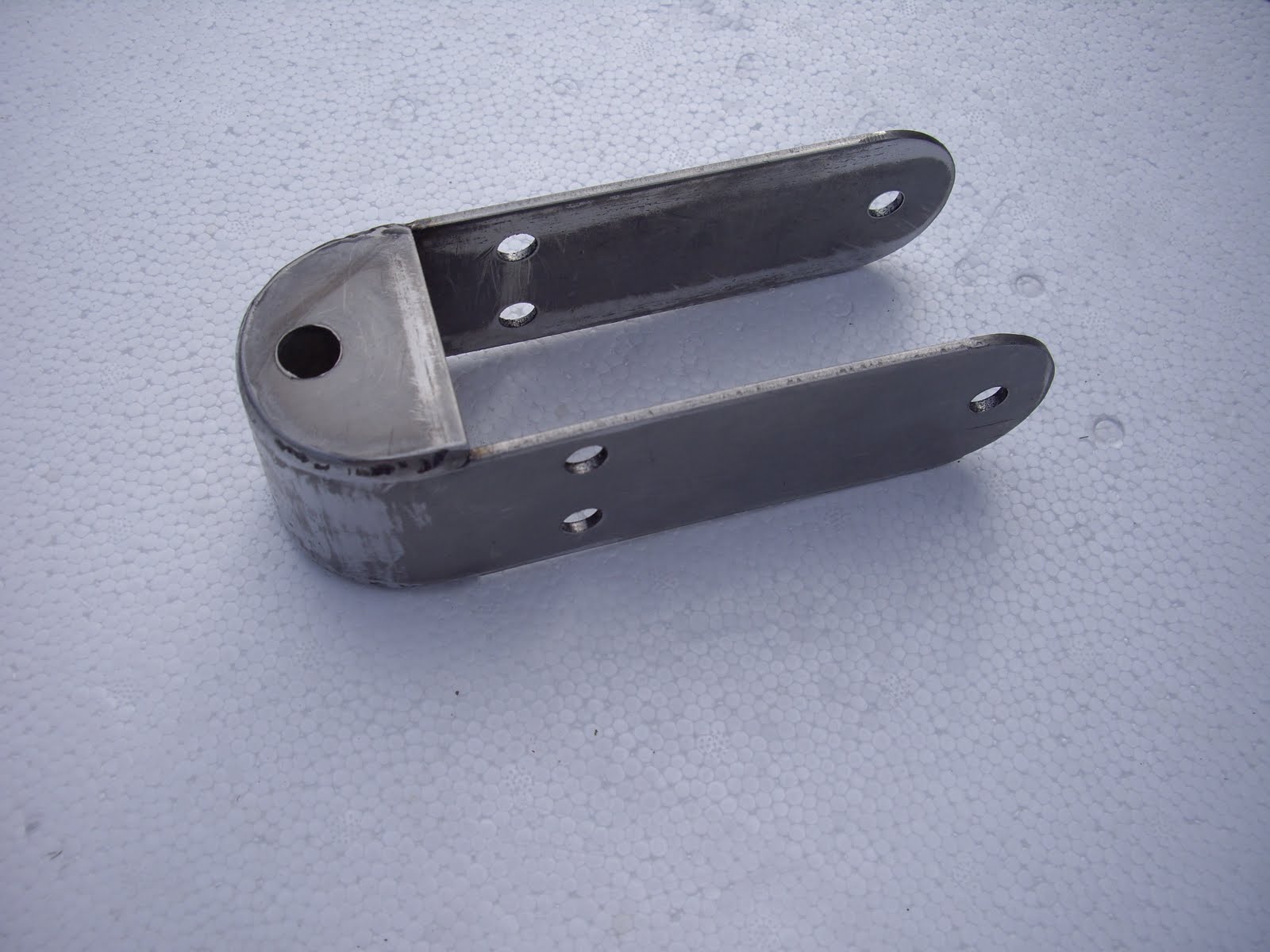
This unit is goes to the base of the rudder and the post gets cut off about one inch above the strap. Holes to mount it on the rudder still need to be drilled in it. If you can read upside down without the need to flip your computer screen over, you can see the 316L printing on the inside of the U-shaped strap.
The new gudgeon in 316 SS is now built. It needs final polishing yet (as do all the new pieces).
The replacement pintles have been welded. Clean-up and polishing are the next steps.
It sure feels good to have this much more work done. Many thanks to Mike Hurd of Hurd's Hardware in Harrisburg, OR for the fine work in finishing up the fabrication of these stainless items that I had pre-fabbed a few months back. Mike had to get some 316 SS rod for the welding of this grade of stainless.
Lots of bits and pieces are accumulating for the continued refit: Moen sink fixtures for the galley and head vanity, primary winches off eBay, a gallon of experimental soy-based paint, ABS plastic for headliner material, and many other items.
In the works is interior LED lighting from a source that has developed some unique products for RVs and boats. The designer and I are communicating via email. Low battery drain and sufficient lighting in both soft white and night-vision red are in the works. Details to follow as progress develops.
This unit is goes to the base of the rudder and the post gets cut off about one inch above the strap. Holes to mount it on the rudder still need to be drilled in it. If you can read upside down without the need to flip your computer screen over, you can see the 316L printing on the inside of the U-shaped strap.
The new gudgeon in 316 SS is now built. It needs final polishing yet (as do all the new pieces).
The replacement pintles have been welded. Clean-up and polishing are the next steps.
It sure feels good to have this much more work done. Many thanks to Mike Hurd of Hurd's Hardware in Harrisburg, OR for the fine work in finishing up the fabrication of these stainless items that I had pre-fabbed a few months back. Mike had to get some 316 SS rod for the welding of this grade of stainless.
Lots of bits and pieces are accumulating for the continued refit: Moen sink fixtures for the galley and head vanity, primary winches off eBay, a gallon of experimental soy-based paint, ABS plastic for headliner material, and many other items.
In the works is interior LED lighting from a source that has developed some unique products for RVs and boats. The designer and I are communicating via email. Low battery drain and sufficient lighting in both soft white and night-vision red are in the works. Details to follow as progress develops.
Friday, February 25, 2011
316L Stainless Steel Replacement
Corrosion: This is what 304 stainless submerged in salt water looks like after a long period of time without a lesser noble metal for protection, namely a zinc sacrificial anode. This is the lower fitting on the rudder (actually shown upside down from how it is attached) that connects the rudder to the skeg. I now am paying the price for not keeping the zincs where they should have been! The oval hole actually was not originally present. That is how much metal was eaten away.
Less corrosion: these two views above of the rudder pintle show how much corrosion occurred while not always submerged. Not as bad as the first two pictures, but still there is damage.
READY FOR WELDING (ALMOST)
New Stainless: two new pintles will be made of 316L stainless steel which is higher in corrosion protection, but still will need a sacrificial zinc for the parts that are submerged. I bought a special band saw blade to do the cutting of these parts. It was laborious and slow at times but nothing like as slow as it would have been if it had all been done with a hacksaw. The blade for the band saw was expensive but worth the cost. I was amazed how well it cut through this hard stainless, as long as I took my time and did not force it.
OLD GUDGEON
Never submerged, this gudgeon survived for over thirty years in remarkably good condition. All the rudder units are being fabricated in 316L SS and will be protected with zinc anodes. Here are the pre-fabbed parts for one of them, plus another angle of the old 304SS gudgeon:
TOO COLD TO WORK RIGHT NOW
It is a cold night here in western Oregon in late February, heading down to the mid teens for a hard freeze, perhaps beating the record low of 18 degrees F set in1962. The outlook is indicating a low of 13F tonight. Already we are down to about 25F and the coldest part of the night is just about sun-up. It is too cold to do any work in the unheated garage, so most of the efforts toward the refit are currently limited to digging for relevant information on-line.A key decision to be made soon is about the winches. ETAK originally had four Barient 21 standard manual winches for both primary and secondary positions. These 21's may be all right as secondaries, but I am concerned about this size for the primary winches. The other big choice relates to whether to go to self-tailing or not. Jim Brown still espouses using non-self-tailers on his designs. Yet, I see a number of Searunners with self-tailing winches. Without the need to tail, cranking in on a genoa sheet is certainly much easier and probably preferred by my first mate. But rapidly dumping one is the big issue. I need to go out on a few more vessels with --tailers and see how fast I can toss off the wraps. Cleating off is another matter. Brown likes to use cam cleats, then move the sheet to horn cleats. Releasing a cam cleat under heavy load can be quite difficult unless one takes a bit of a pull on the winch, and with the urgency of releasing the sheet in a sudden gust, such a tactic can be slow at best.
The other big issue is cost! The larger the winch, the higher the price! New ones don't come cheap, and going up one size larger increases the cost significantly. As I write this, there is a pair of new Harken B44.2STA winches on Ebay with a minimum bid of $1750. The best retail price I can find is about $1300 each for this winch. So far, no one has bid on them, and they would represent a substantial savings over buying two at retail, and that is a delivered price. Hutton-Arco winches from Australia are another option. They can be bought for about $1780 for a pair of 40 ST's , plus shipping, and the company will take a trade in of my old ones. But the 45ST Arco winches are closer to the Harken 44's and these Arco units cost $2240 a pair, plus shipping. Yikes! Anyone reading this with any experience with the Hutton-Arco winches? Andersen 40 self-tailers run about $2534a pair from Defender, plus shipping.
It will take a big chunk of change to upgrade winches in any case. Maybe I will just put the old Barient 21's back on and see what comes along down the pike (or, seaway). Hmmm... Choices and decisions.
Thursday, February 17, 2011
Paint helps!
"After" and "Before" shots of the front half of ETAK as seen from the first spreaders. Not showing is the gray primer that is under the first coat of the white primer. It was hot working on that gray in the sun! It also kicked off the white quite quickly giving me precious little time to even the coat out. In the picture above, you can see it is a first coat where the roller has not had a second pass over it. The gray shows through quite well through this thin first coat. Subsequent coats will even out the white so it is uniform. This Z-Spar two part epoxy primer is excellent to work with (except for the fumes), and sands nicely once fully cured. The gray was actually the same paint; I just added some black tint to it. That dye is worse than Never-Sieze! If you just look at it, it gets on your hands, tools, clothing. Because I was not concerned about a match with the gray, each batch had a slightly different amount added to it, so the gray varied in darkness. We really looked like a botched Navy pain job!
What a lift it gave us both to see some paint on the old gal. All those weeks of sanding, filling, sanding, and more filling were getting to us. So putting a bit of color on to hide the body work sure did lift our spirits. Here are some other photos taken during the painting spree:
https://picasaweb.google.com/rannmillar/ETAKRefurb#
What a lift it gave us both to see some paint on the old gal. All those weeks of sanding, filling, sanding, and more filling were getting to us. So putting a bit of color on to hide the body work sure did lift our spirits. Here are some other photos taken during the painting spree:
https://picasaweb.google.com/rannmillar/ETAKRefurb#
Monday, February 7, 2011
Wet Locker Hatches
The time-consuming rebuild of the wet lockers and hatches is progressing nicely, thanks to the diligent efforts of my first mate. She has laboriously touched up the edges of the hatches while I have been adding the bog to the edges of the lockers themselves. The fit is really quite nice now. Take a look at this photo to see how clean the fit line is. Once we get the two part primer on, all the blotches of color disparity will disappear and we won't be looking like a botched camouflage sea-battle vessel.
Wednesday, January 26, 2011
Progress Since Last Post
This Lewmar 20 Ocean Hatch has a major amount of crazing in the acrylic. A couple of firms advertise online to repair just about any hatch at much less than the replacement cost of a new one. I sent an email off to both firms. One responded and quoted me a price just about the same that it will cost me for a new one online, including shipping! The other firm never responded to my email. Guess what I will be doing? That's right, buying a new one to replace this one.
Looking straight down on the port forward wing locker, you can see how I am adding the 1/4" inch of epoxy filler to extend the edge of the plywood all in plastic to avoid the wet rot I had before. Using a piece of scrap wood, I put on 3M 471 tape and make a channel for the bog. If you look carefully at the top edge in this photo, you can see one of the completed edges of the deck plywood and bog combination. Once the edge is painted, it will disappear and not be visible all the while it is protecting the edge of the plywood from moisture penetration.
The first step was for my wife and me to add about 1/4" of bog to the wet locker hatches. Next, I routered the edges out on the deck around the wet locker, and this photo shows how I have added the 1/4" back in with bog. Thanks to Mark Johnson for the tip on using this 3M tape for this type of operation. It is expensive but does the trick. It reminds me of electrical tape in blue. I wonder if electrical tape will do as well at a much lower cost? Hmmmm..., maybe it is time for an experiment. The resin will not stick to either side of the tape once the epoxy has kicked off, but it does need to kick before removal.
Here is another picture of the process in two of the self-draining wet lockers with the scrap wood and tape curing in good sunlight.
No, this is not graffiti or modern art. Doreen had gone around and marked areas that need attention with thin fairing or pin-hole filling prior to painting.
More areas needing fairing.
Work has been progressing daily although it seems like not much is happening when on lives with the project. It is by looking back at photos of a previous state that allows one to appreciate the progress gained. The goal right now is to get all seven of the self-draining lockers totally mummified in epoxy to avoid the problems of rot we had in the past. When all the work is done, there will be a layer of fiberglass cloth on all surfaces in the lockers as well as the resin filler around all edges of plywood. The last step will be to get protective paint on all surfaces to keep the sun off the epoxy. Once the wet lockers meet our satisfaction, we will continue the ongoing deck preparation for the two-part primer prior to finish painting.
Mark Johnson of Delphys offered another tip I was not aware of regarding the paint. He said to put a very dark undercoat beneath the top coat of primer. It is to protect the of epoxy which is damaged by sunlight. I always thought that just getting paint on the epoxy would be enough. But I have seen areas where I have only epoxy and white paint not covering any wood such as over an old bolt hole. Looking from he inside out, I can see light through the paint and epoxy indicating light does in fact penetrate the light colored paint.
I am sure I will get some funny looks from folks in the marina when they see the dark battleship gray of the first coat. " What's that crazy trimaran guy doing? Trying to be a stealth sailor?" I can just imagine several of them commenting among themselves. Then when I get a coat of white on, the will realize I wasn't crazy after all (or that Doreen convinced me we should not attempt being stealth sailors).
It is amazing how much work goes into preparation for painting. We are both getting tired of doing body work, b ut we know that it will pay off when the final coat of paint and non-skid goes on.
Looking straight down on the port forward wing locker, you can see how I am adding the 1/4" inch of epoxy filler to extend the edge of the plywood all in plastic to avoid the wet rot I had before. Using a piece of scrap wood, I put on 3M 471 tape and make a channel for the bog. If you look carefully at the top edge in this photo, you can see one of the completed edges of the deck plywood and bog combination. Once the edge is painted, it will disappear and not be visible all the while it is protecting the edge of the plywood from moisture penetration.
The first step was for my wife and me to add about 1/4" of bog to the wet locker hatches. Next, I routered the edges out on the deck around the wet locker, and this photo shows how I have added the 1/4" back in with bog. Thanks to Mark Johnson for the tip on using this 3M tape for this type of operation. It is expensive but does the trick. It reminds me of electrical tape in blue. I wonder if electrical tape will do as well at a much lower cost? Hmmmm..., maybe it is time for an experiment. The resin will not stick to either side of the tape once the epoxy has kicked off, but it does need to kick before removal.
Here is another picture of the process in two of the self-draining wet lockers with the scrap wood and tape curing in good sunlight.
No, this is not graffiti or modern art. Doreen had gone around and marked areas that need attention with thin fairing or pin-hole filling prior to painting.
More areas needing fairing.
Work has been progressing daily although it seems like not much is happening when on lives with the project. It is by looking back at photos of a previous state that allows one to appreciate the progress gained. The goal right now is to get all seven of the self-draining lockers totally mummified in epoxy to avoid the problems of rot we had in the past. When all the work is done, there will be a layer of fiberglass cloth on all surfaces in the lockers as well as the resin filler around all edges of plywood. The last step will be to get protective paint on all surfaces to keep the sun off the epoxy. Once the wet lockers meet our satisfaction, we will continue the ongoing deck preparation for the two-part primer prior to finish painting.
Mark Johnson of Delphys offered another tip I was not aware of regarding the paint. He said to put a very dark undercoat beneath the top coat of primer. It is to protect the of epoxy which is damaged by sunlight. I always thought that just getting paint on the epoxy would be enough. But I have seen areas where I have only epoxy and white paint not covering any wood such as over an old bolt hole. Looking from he inside out, I can see light through the paint and epoxy indicating light does in fact penetrate the light colored paint.
I am sure I will get some funny looks from folks in the marina when they see the dark battleship gray of the first coat. " What's that crazy trimaran guy doing? Trying to be a stealth sailor?" I can just imagine several of them commenting among themselves. Then when I get a coat of white on, the will realize I wasn't crazy after all (or that Doreen convinced me we should not attempt being stealth sailors).
It is amazing how much work goes into preparation for painting. We are both getting tired of doing body work, b ut we know that it will pay off when the final coat of paint and non-skid goes on.
Subscribe to:
Posts (Atom)